Classify before you commit.
Every kinetic engagement decision flows through a multi-stage classification pipeline. RCS signature, optical profile, and flight kinematics are fused in under 120 milliseconds — before committing a round. No engagement without confidence above the operator-defined threshold.
AI Classification Pipeline
RCS alone cannot reliably distinguish a threatening UAS from a bird at 1 km. At 0.001–0.05 m², small commercial drones overlap with birds, bats, and weather artifacts. ARES-1 does not attempt single-sensor classification.
The classification problem for small UAS is fundamentally different from manned aircraft detection. Commercial drones operate in the 0.001–0.05 m² RCS range — overlapping substantially with birds, bats, and large insects. Single-sensor classification at those RCS values carries false-positive rates that no military operator will accept.
ARES-1's multi-modal approach combines three independent feature streams: radar cross-section temporal signature, electro-optical shape classification, and flight kinematic profile. Each stream produces an independent probability estimate. The fusion layer applies a Bayesian combination with learned covariance structure from our training dataset.
The result is a classification confidence score. Engagements are only authorized above a threshold that the operator sets at mission planning. Below threshold: the system continues tracking but does not dispatch a round.
Multi-Target Engagement Queue
A single ARES-1 unit holds 8 simultaneous threat tracks in the engagement queue. Priority is weighted by proximity, inbound speed, and time-to-perimeter — not first-in-first-out.
Swarm scenarios present a fundamentally different engagement problem than single-target intercept. Eight drones on diverging vectors — with different ranges, speeds, and threat priorities — cannot be handled with a first-in-first-out queue. ARES-1's engagement sequencer uses a weighted priority function that combines threat proximity, heading-to-target, speed, and remaining engagement time before the target reaches the defended perimeter.
When engagement probability on a given track drops below threshold — because the track has moved outside the engagement envelope — the system re-sequences and reallocates remaining magazine capacity to the next-highest-priority track. This fallback logic is operator-configurable: conservative operators can set higher safety margins; high-tempo environments can lower the fallback threshold.
No single operator is required to make per-target decisions. The operator defines the ROE parameters at mission start. The system executes within those parameters autonomously until the operator intervenes or the engagement is complete.
| Priority | Track | Range | P(kill) | T-to-perimeter |
|---|---|---|---|---|
| 01 | T-002 | 1,220 m | 0.81 | 12 s |
| 02 | T-006 | 1,680 m | 0.76 | 18 s |
| 03 | T-001 | 2,840 m | 0.72 | 34 s |
| 04 | T-003 | 3,100 m | 0.64 | 41 s |
| 05 | T-004 | 950 m | — | CLASSIFYING |
Sensor Fusion Architecture
Three independent input streams — phased-array radar, dual EO/IR optical, and ADS-B — feed a joint probabilistic representation. A degraded or failed sensor is down-weighted automatically. The system does not fail closed.
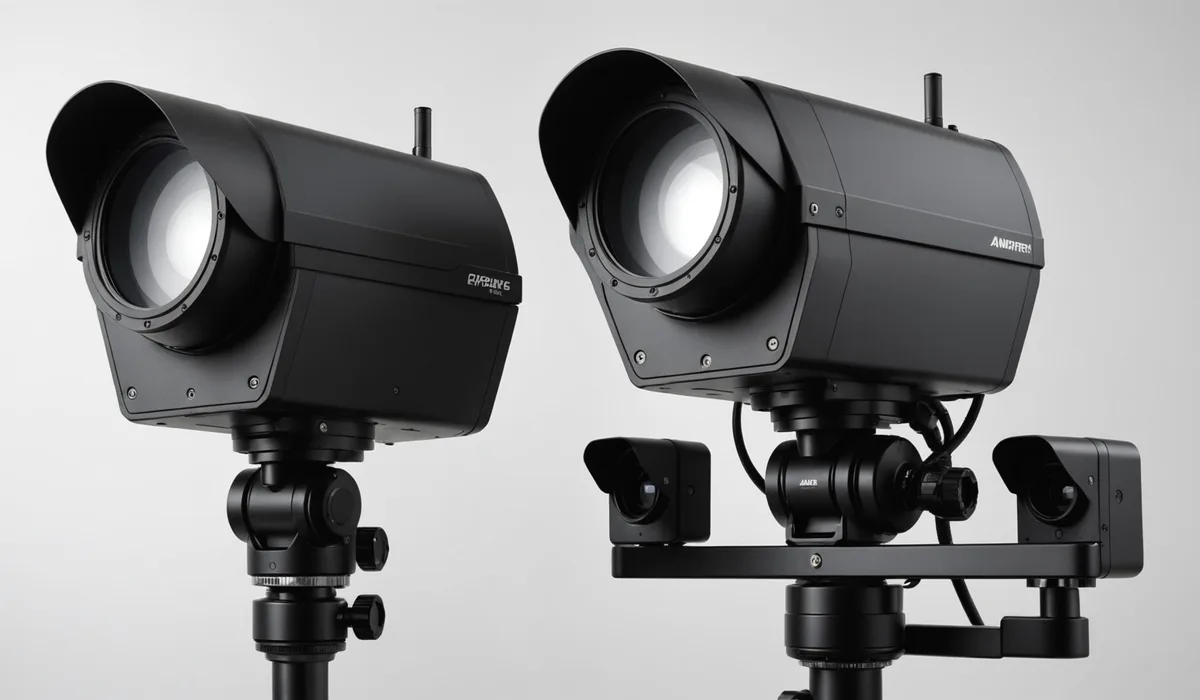
The ARES-1 sensor suite combines a flat-panel phased-array radar with a dual-band EO/IR optical assembly. Radar provides long-range acquisition and RCS characterization out to 3.5 km. EO/IR provides shape classification and kinematic refinement at ranges below 1.5 km where optical resolution is sufficient.
ADS-B receiver data is cross-correlated as a negative filter — cooperative aircraft broadcasting transponder data are automatically excluded from the threat classification pipeline, reducing cognitive load on the operator and preventing engagement of registered air traffic.
Sensor fusion is not a voting system. Each sensor produces a probabilistic feature vector, and the fusion model combines these in a learned latent space. Degraded sensors are down-weighted automatically — the system continues operating at reduced confidence rather than failing closed.
Model Development: Adversarial by Design
We test against the worst cases, not the average cases. Threat drones increasingly use counter-detection measures — radar-absorbing coatings, non-standard flight profiles, formation flying to reduce per-unit RCS. Our training data is built with adversarial inputs in mind.
The training dataset combines synthetic flight data generated by a physics-based simulator, real-world RCS measurements from a controlled test range near Redstone Arsenal, and augmentation layers that simulate degraded sensor conditions (clutter, ground reflections, precipitation).
Model validation is run quarterly against new threat profiles as the commercial drone market evolves. Firmware updates are delivered without requiring system downtime on fixed installations.
- Synthetic simulation: 2.4M flight episodes
- Real-world RCS measurements: 18 drone models
- Adversarial augmentation: 340k edge-case samples
- Benign traffic: birds, aircraft, weather artifacts
- Classification accuracy target: > 94% (1 km)
- False positive cap: < 0.8%
- Quarterly adversarial re-evaluation
- OTA model updates, no system downtime