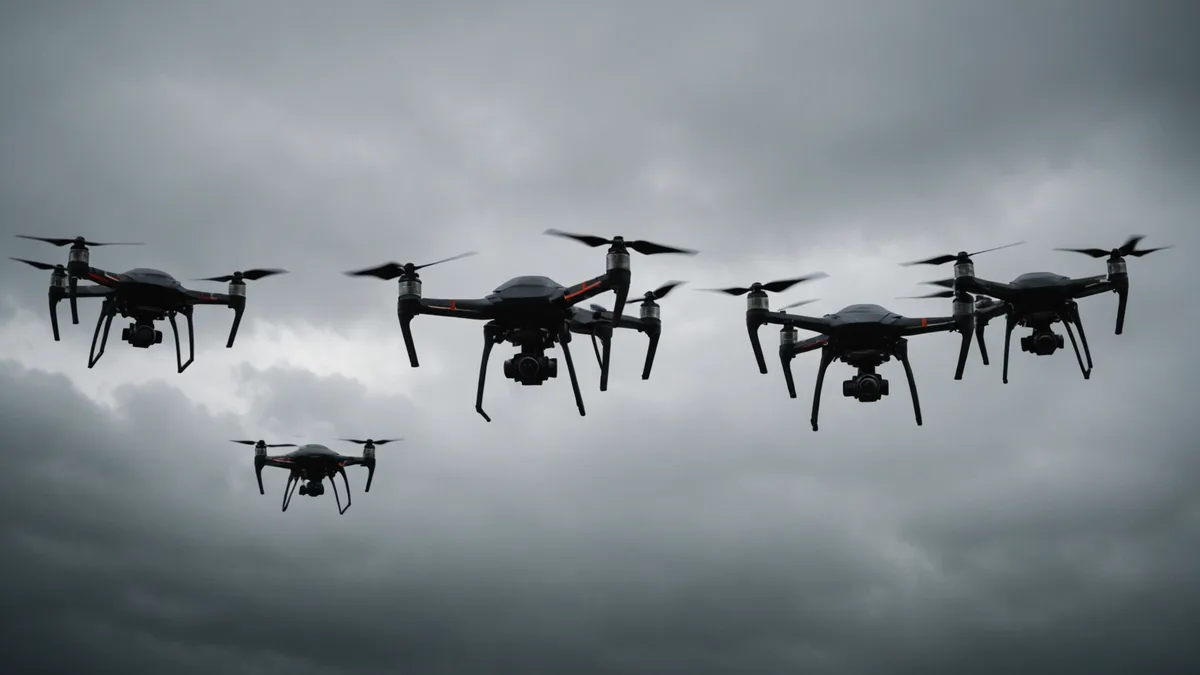
For most of the last decade, electronic warfare was the dominant answer to drone threats. Jam the control link, the drone falls. Spoof the GPS, the drone goes home or lands. It was a clean solution for a threat that was, at the time, relatively unsophisticated: off-the-shelf commercial hardware, unencrypted control protocols, consumer GPS chips with no anti-spoofing capability.
That threat profile has changed. The high-end of the tactical drone market — the part that matters in contested environments — has moved well past the assumptions that made jamming dominant. And the consequence, for anyone designing counter-UAS systems, is that EW-only defeat is no longer sufficient against the full threat population. This is not an indictment of electronic warfare. It's a statement about what the threat has become and what that requires of the response.
What Frequency-Hopping and Encrypted Links Changed
The RF landscape for drone control has changed substantially since roughly 2018. Several factors compound:
Frequency-hopping spread spectrum (FHSS): FHSS control systems — now common in mid-market commercial controllers using protocols derived from the FrSky and ExpressLRS ecosystems, and in higher-end military-adapted systems — hop across a predetermined frequency sequence at rates from 50 to several hundred hops per second. A noise jammer covering the entire 2.4 GHz and 5.8 GHz bands can still disrupt FHSS links, but it requires radiated power that creates significant collateral interference, and it still fails against systems that have shifted to licensed spectrum or non-ISM bands.
Encrypted control links: Military and paramilitary actors have access to drone command-and-control systems with AES-128 or AES-256 encrypted links. Jamming encrypted links still works — you don't need to decrypt to disrupt — but it raises the power and bandwidth requirements and eliminates spoofing as a defeat mechanism entirely. You cannot inject false GPS or control signals into an encrypted link without the key.
Autonomous and pre-programmed flight: The most significant evolution is that RF control is no longer necessary for a threat drone to execute a mission. A drone that carries a pre-loaded GPS waypoint sequence and inertial navigation fallback requires no live RF link to operate. Jamming a drone that has already launched on its programmed trajectory does nothing. GPS spoofing adds complexity — if the drone's mission computer recognizes GPS signal inconsistencies, it may switch to inertial navigation and continue on a degraded but functional course.
None of this means that jamming is useless. Against unsophisticated threats — which still represent a substantial fraction of the current lower-tier threat population — broadband RF jamming is effective and cost-efficient. The point is that the threat population is no longer homogeneous, and a defeat system that relies entirely on RF disruption is effective against part of the threat but not all of it.
Why Kinetic Defeat Is Agnostic to the Control Link
A kinetic interceptor doesn't care about the drone's control protocol. It doesn't matter whether the threat is on an encrypted FHSS link, flying autonomously on GPS waypoints, or operating on a fiber-optic tether — none of that changes the physical fact that the airframe occupies a volume of space that a kinetic round can be directed into. The control channel is irrelevant to the intercept problem.
This is what makes kinetic defeat complementary to, rather than competitive with, electronic warfare in a layered counter-UAS architecture. EW handles the easy cases quickly and cheaply — no physical round consumed, immediate effect when it works. Kinetic intercept handles the cases where EW fails: autonomous drones, encrypted links, RF-silent terminal phase execution. In a well-designed layered system, the transition between EW and kinetic modes is driven by the classification and track data — if EW disruption is confirmed effective (drone deviates from inbound track or loses altitude), you don't need to commit a kinetic round. If the drone continues on track after jamming attempt, kinetic engagement initiates without operator intervention.
The requirement that kinetic engagement be available as a fallback is not a statement about the frequency of EW failure. In many deployments, EW may handle a large fraction of actual engagement events. It's a statement about what happens when EW fails against a high-consequence threat. That scenario — a threat that cannot be electronically disrupted — is precisely the scenario where you most need the kinetic option.
Swarm Saturation and the Throughput Problem
Beyond individual drone defeat, swarm saturation presents a fundamentally different problem. A coordinated swarm launch of 12–20 small UAS on simultaneous or near-simultaneous inbound trajectories is designed to exceed the engagement throughput of any single-point defense system. If your counter-UAS system can engage one threat per 3 seconds, a 15-unit swarm entering engagement range simultaneously creates a throughput deficit — those drones reach the protected asset before your system can engage them all.
Electronic warfare against swarms has specific problems:
- Power scaling: Broadband jamming power requirements scale with swarm density in certain configurations. Jamming 15 simultaneous targets isn't harder than jamming one from an EW standpoint, but it doesn't guarantee simultaneous defeat of all 15 either — particularly when different units are using different control protocols.
- Probing behavior: An adversary that deliberately staggers swarm timing — 5 units first, followed by 10 units 8 seconds later — can probe the EW system's response and observe which units succeed in continuing their approach.
- Autonomous terminal phase: Pre-programmed swarm units that execute a final approach maneuver after EW disruption of the lead units can use the EW system's own response signature as indirect targeting confirmation.
Kinetic defeat against swarms has a different but also real throughput problem: a single-barrel launcher has a hard limit on rounds-per-minute, and multi-target engagement requires either multiple launchers or a fire control system capable of re-targeting faster than the swarm arrival rate. This is the engineering problem we're working on directly in ARES-1: designing engagement sequencing that can handle multi-target threat timelines without requiring human decision-making at each engagement event.
The EMCON Dimension
Emissions control (EMCON) is an operational consideration that complicates pure EW approaches in ways that are often underweighted. Active jamming is itself an emissions source. A broadband jammer that can be direction-found from the target drone's receiver — or from an accompanying ISR platform — can reveal the location of the defended asset and its counter-UAS system. In environments where threat actors have ISR assets, active jamming may be operationally problematic even when technically effective.
Radar for detection and tracking is similarly an RF emissions source, though the probability of intercept is typically lower for narrow-beam radar than for broadband jamming. The key point is that kinetic defeat, combined with passive EO/IR detection, can operate with substantially lower RF emissions than an EW-dominant counter-UAS architecture. For EMCON-critical applications — perimeter defense where hiding the location of the defended installation is itself part of the security posture — lower-emissions architectures have operational value beyond just technical performance.
We're not claiming passive-only operation is appropriate for all deployments. Active radar for detection significantly outperforms passive sensors at the range and weather conditions that matter for real defense. But the option to minimize RF emissions without sacrificing kinetic defeat capability is a design choice that some operators need, and it's one that an EW-dominant architecture cannot offer.
Altitude-Informed Defeat Selection
A nuance that gets lost in high-level counter-UAS architecture debates: the optimal defeat mechanism often depends on the threat's altitude and approach profile. RF jamming is generally more effective at higher altitudes and longer ranges — the jamming platform's power advantage is greater relative to the drone's link budget at distance, and at higher altitudes there are fewer terrain-multipath complications that can reinforce the drone's received signal.
At very low altitudes and short ranges — below 50 meters, inside 300 meters — the calculus shifts. Jamming effectiveness degrades as the drone enters the terrain-multipath environment. Simultaneously, kinetic intercept accuracy improves as range decreases and engagement geometry becomes more favorable. The combination suggests a defeat selection logic that isn't purely "try EW first, then kinetic," but rather a function of both the current engagement state and the threat's current position.
In our current architecture, defeat modality selection is a continuous recommendation from the engagement authorization system, not a static sequential ladder. As track data accumulates and the threat's approach trajectory becomes clearer, the system estimates the probability of effective disruption by each available defeat mechanism and recommends engagement timing accordingly. This runs ahead of operator decision timelines — the recommendation is presented as a prioritized action, not a question waiting for input.
What This Means for System Architecture
If you accept the argument that electronic warfare alone is insufficient against the full current threat population, several architectural conclusions follow:
First, kinetic intercept is not a fallback of last resort — it's a first-class defeat mechanism that should be sized and resourced to handle realistic threat loads independently of EW effectiveness in any given engagement. Sizing it as a "backup" tends to produce systems that are chronically under-resourced on kinetic throughput.
Second, the coordination between EW and kinetic defeat requires a shared picture of the threat. Both systems need to be working from the same track data, with clear logic for which mechanism gets priority at what point in the engagement. Ad-hoc integration of separately developed EW and kinetic systems around a shared track tends to produce coordination failures at exactly the worst moments.
Third, swarm defeat requires engagement throughput engineering from the outset. A system that achieves excellent single-target performance but serializes multi-target engagement will be overwhelmed by even a modest coordinated swarm. Throughput is a system-level requirement, not a feature you add after the single-target architecture is finalized.
The threat has adapted. The response architecture needs to reflect where the threat actually is, not where it was five years ago.