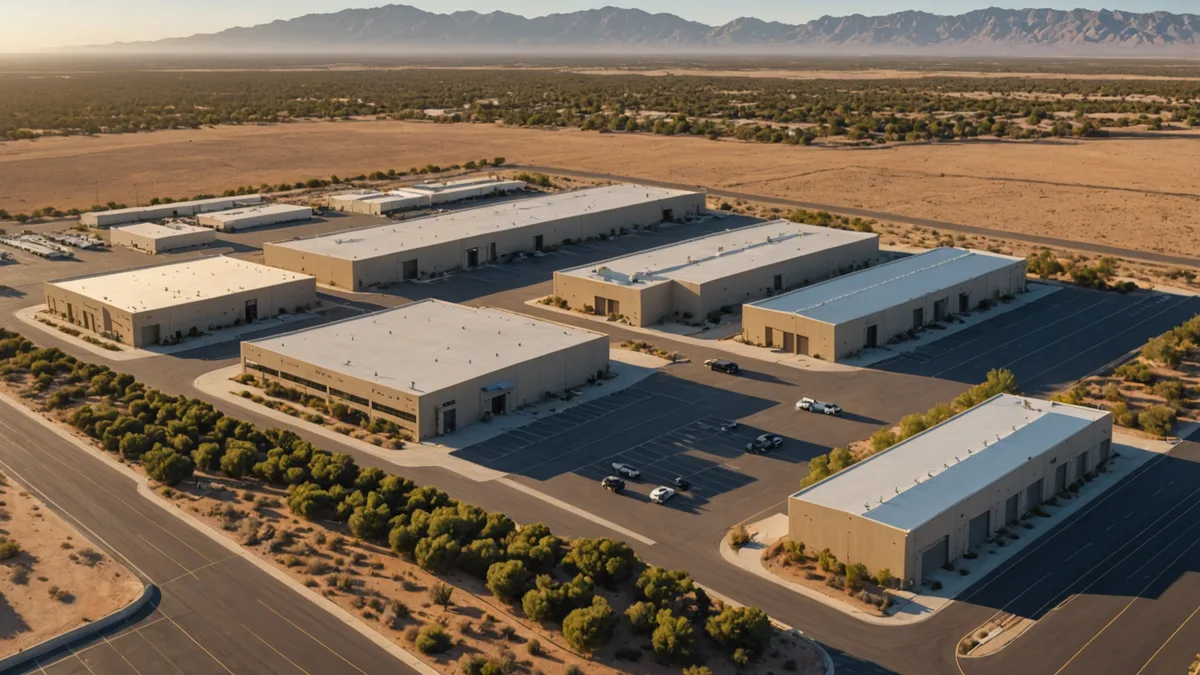
We started Askarl Defense in Huntsville because of what we saw around us, not because of what we read in industry reports. Located at Redstone Gateway — about three miles from the main Redstone Arsenal gate — we've had a front-row view of how the Army thinks about drone threats, how the ecosystem around AMCOM and DEVCOM Aviation and Missile Center has been responding, and how the gap between threat awareness and deployed counter-UAS capability has evolved over the past couple of years.
What follows is our read of the threat landscape as we understand it from that vantage point — grounded in open-source information, publicly available Army doctrine, and the conversations that happen naturally when you're building a counter-drone system in a city full of people who have been watching drone threats up close. We're not claiming special access to classified assessments. We're sharing the threat picture that shapes our engineering decisions.
The Threat Has Layered and Diversified
The drone threat landscape in 2025 is not the single-tier problem it appeared to be in 2019. In the early phase of the commercial drone proliferation, the primary concern was Group 1 small UAS — sub-20 lb quadrotors and small fixed-wing platforms — operating individually or in small numbers as improvised attack platforms. Those threats are real and still present. But they're now part of a layered threat environment that includes:
Group 1 swarms: Coordinated launches of 10–30 units, typically smaller quadrotors or fixed-wing platforms, designed to saturate the engagement timeline of any single-point defender. The key characteristic is not individual lethality — each unit may carry a small payload — but collective saturation. Swarm coordination doesn't require sophisticated mesh networking; sequential pre-programmed launches with staggered timing can approximate swarm saturation without real-time unit-to-unit communication.
Larger Group 2 UAS used for precision strike: The 21–55 lb category, which overlaps with commercial platforms like larger fixed-wing ISR drones and modified agricultural UAS, has become relevant for precision strike applications in conflicts observed from 2022 onward. These platforms can carry larger warheads, have longer range, and are harder to detect at low altitude than smaller quadrotors. Their RCS may not differ dramatically from Group 1 platforms in some aspect angles, but their kinetic energy on impact is substantially higher.
RF-silent and pre-programmed threats: Both categories increasingly include units that operate without a live RF control link for the terminal approach phase. Pre-loaded waypoint sequences, combined with optical terminal homing, can execute a final attack maneuver with no RF emissions. This has direct implications for EW-centric counter-UAS: if you're waiting for a detectable RF signature to trigger your defensive response, you may not get one.
The Infrastructure Vulnerability Dimension
Redstone Arsenal and the broader Huntsville defense corridor have a specific infrastructure characteristic that's directly relevant to counter-UAS: the concentration of high-value fixed installations within a relatively compact geographic area. Aviation and Missile Command, the NASA Marshall Space Flight Center complex, and multiple prime contractor facilities are all within a few miles of each other. The fixed nature of these assets — they can't maneuver out of threat range — means the defensive requirement is full-time persistent coverage, not just responsive capacity.
That's a different system design requirement than a mobile force protection application. A force protection counter-UAS system on a vehicle convoy needs to operate intermittently, respond to dynamic threat directions, and be transportable. A fixed-site defense system can afford heavier sensors, more power, and better computational resources, but it must maintain continuous watch without downtime for maintenance windows during threat periods. The duty cycle requirement is essentially 24/7.
This shapes our ARES-1 architecture in concrete ways. We design for continuous radar watch at degraded function during maintenance, not full down-for-maintenance periods. The sensor architecture has component-level redundancy in the most critical detection functions, so a single component failure doesn't create a watch gap. These aren't features we added for marketing purposes — they're requirements that emerge directly from the fixed-site threat model we see from our location here.
What We've Observed in the Threat Assessment Community
The discourse around drone threats in the Huntsville defense community has shifted noticeably between 2022 and now. In 2022, the dominant discussion was detection range — "can we see them in time?" — and the primary technology focus was on improving radar sensitivity for small RCS targets. That was the right first question.
By late 2023, the discussion had shifted to defeat mechanism adequacy. Detection was understood to be achievable with current sensor technology at operationally relevant ranges. The harder question became: once you've detected and classified a threat, can you defeat it before it reaches the defended asset? And can you defeat multiple simultaneous threats?
The Army's public counter-UAS doctrine — reflected in FM 3-01 (Air and Missile Defense Operations) and the subsequent UAS defeat supplemental publications — articulates a layered architecture that includes electronic attack, directed energy, and kinetic defeat. The doctrine is sound. The gap, as publicly discussed in various open forums around the Redstone community, is in kinetic defeat throughput: the capacity to execute multiple engagements per minute against a coordinated threat without requiring operator decision-making at each engagement step.
That's the specific gap Askarl Defense is building against. Not detection (that's a solved problem for the threat ranges that matter), not classification (solvable with current sensor fusion approaches), and not single-target kinetic defeat (demonstrated by multiple existing systems). The problem is autonomous multi-target engagement throughput — and it remains underserved in the current fielded counter-UAS inventory.
The Low-Altitude Problem
One aspect of the threat that the community around us discusses with particular directness: the low-altitude band below 100 meters AGL presents detection and engagement challenges that are qualitatively different from higher-altitude threats.
At low altitude, radar ground clutter is a persistent challenge. The same terrain features that return radar energy at ground level — buildings, vehicles, trees, terrain relief — create false tracks and mask genuine drone returns in ground-clutter-heavy environments. Traditional MTI (moving target indication) processing helps, but at the low speeds of hovering or slow-transiting Group 1 UAS (3–8 m/s for some threat profiles), the Doppler shift is small enough to be partially masked by moving ground clutter from vegetation in wind.
EO/IR sensors at low altitude face their own challenges: the target subtends a very small angular size even at 150 meters range, and ground-level backgrounds in built environments are cluttered enough that detection latency is higher than at altitude-dominant approaches. The combination means that the final 100–150 meters of a low-altitude inbound threat often involves the degraded performance of every sensor in the system — not the best performance.
We've designed our sensor processing architecture around this expected degradation zone. The relevant parameter is not peak performance at ideal conditions but minimum acceptable track quality at the inner edge of the engagement envelope. If the track quality at 100 meters and 30 meters altitude is sufficient to produce a valid engagement solution, the system can function in the scenario that matters most.
Threat Evolution Cadence
If you talk to people who have been watching drone threats operationally — in the Huntsville community, in the service branches, in the contractor community — one observation comes up consistently: the threat is evolving faster than the procurement cycle can respond.
The specific concern is not that any one current threat is undefeatable. It's that the time from new threat concept appearing in a conflict theater to that threat being available to lower-tier actors as a commodity capability has compressed significantly. What required specialized technical capability to deploy in 2019 is available as a configurable kit in 2024. The procurement-to-fielding timeline for a new counter-UAS system is 3–7 years. The threat proliferation timeline is 12–24 months.
This mismatch has architectural implications for defense system design. Systems that are optimized specifically against the current threat profile — a fixed set of platform types with known characteristics — will be obsolescent against the threat population that exists when they actually reach operational deployment. Systems that are designed around general kinematic and physical engagement principles — detect anything flying, track it, engage it based on behavior rather than specific RF or RCS signature — are more resilient to threat evolution.
That's partly why we've structured ARES-1's classification architecture around multi-modal track behavior rather than specific threat fingerprints. A classification system that says "engage anything with this specific RCS profile at this specific frequency" breaks when the threat changes its construction materials. A classification system that says "engage any unpowered-flight-pattern UAS that fails an authorization challenge and exhibits a converging track on the protected asset" is resilient to a much wider range of threat variations.
The Question We're Still Working On
There's a threat category that we don't have a complete answer for yet, and we'd rather say that directly than pretend otherwise: very small, very low, very slow Group 1 threats — sub-250g UAS flying below 15 meters at speeds under 5 m/s — present genuine detection challenges at the ranges needed for effective kinetic intercept. The RCS at those sizes is at or below practical radar detection floors in ground-clutter environments. EO/IR can detect them, but at that altitude and with ground backgrounds, detection latency is high enough that the engagement window is tight.
We're not the only ones working on this problem, and we don't expect it to be unsolvable. But the current ARES-1 architecture is sized and tested against Group 1 UAS above the 250g, 15-meter, 5 m/s threshold. Below that, we give an honest answer: it's harder, and we're still developing the solution for that specific threat band.
Threat honesty is part of building credibility in a community that will quickly see through exaggerated capability claims. From Huntsville, you learn early: the people you're selling to usually know more about the problem than the salespeople do.