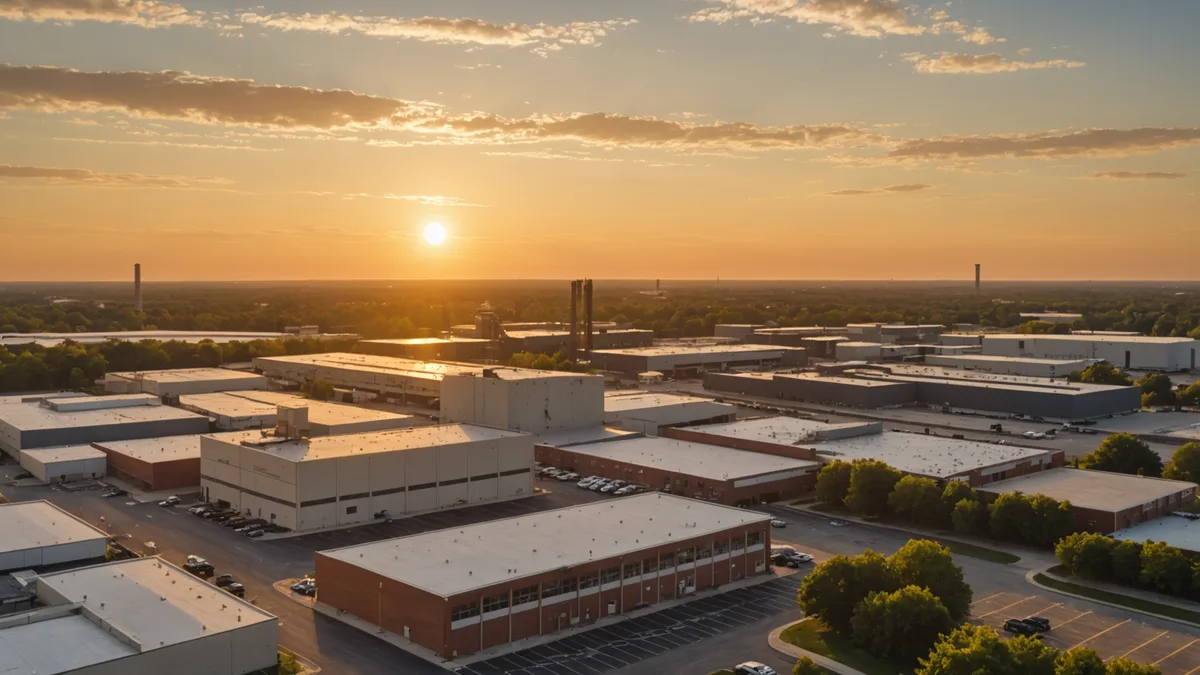
We get this question at every industry event: why are you in Huntsville? The subtext is usually: shouldn't a defense startup be in the DC metro, near the Pentagon, or in San Diego, near the Navy's acquisition corridors? The honest answer is that we looked at what we needed to build ARES-1 and concluded that Huntsville has a concentration of resources for this specific problem that no other geography in the United States can match.
That's not civic boosterism. It's an engineering argument.
Redstone Arsenal and the Army Acquisition Ecosystem
Redstone Arsenal hosts AMCOM — the Army Aviation and Missile Command — which manages the Army's portfolio of aviation, missile, and counter-rocket/artillery/mortar systems. It's also home to the Program Executive Office for Missiles and Space, PEO Aviation, the Missile Defense Agency, and a cluster of Army Labs including the Aviation and Missile Research, Development, and Engineering Center (AMRDEC). These aren't adjacent to where we work — they're within a few miles of our office at 4100 Redstone Gateway.
For a company building autonomous kinetic interceptors, proximity to AMRDEC specifically matters. AMRDEC operates the Systems Simulation, Software and Integration Directorate, which houses the propulsion, guidance, and fire control engineering expertise that is directly relevant to what we're building. Access to technical exchange meetings with AMRDEC engineers is a function of proximity and relationship — you can't participate in the organic engineering conversation from across the country. We're at the table in a way that a Northern Virginia or San Diego company building the same product would not be.
The Test and Evaluation Infrastructure
Testing a kinetic counter-drone system requires an outdoor range, airspace that can be temporarily restricted, and targets. At Redstone, the AMRDEC Propulsion Test Facility and the Test, Measurement, and Diagnostic Equipment Support activity at Redstone Test Center provide the physical test infrastructure. The Redstone Test Center's ranges can accommodate small projectile testing under an existing range-use agreement framework that takes weeks to set up, not months — because the infrastructure exists and the processes are defined.
Separately, the Yuma Proving Ground in Arizona and White Sands Missile Range in New Mexico are the canonical Army test ranges for missile and drone intercept testing, and both have defined pathways for small business test access. But access to those ranges starts from knowing the right people and understanding the scheduling process — both of which are dramatically easier when you're operating out of the Arsenal corridor than from the other side of the country.
We've run early flight tests at a private range in northern Alabama, not on Arsenal property. We're not saying we have privileged access to government test infrastructure that others don't — we're saying the network that gets you to the door faster is geographically concentrated here.
The Talent Pipeline: UAH and the CUAS Skills Concentration
The University of Alabama in Huntsville graduates engineers with specific depth in guidance, navigation, and control (GNC), autonomous systems, and embedded software that is directly applicable to what we're building. UAH's Propulsion Research Center and the associated graduate programs produce engineers who have written PID controllers, tuned Kalman filters, and designed propulsion test articles before they graduate — not as coursework exercises, but as part of funded research programs.
Huntsville also has a deep bench of experienced aerospace engineers from the legacy missile and rocket programs that have operated here since the Apollo era. Engineers with 20+ years of experience on Patriot, THAAD, and other missile defense programs are available for consulting, advisory roles, or full-time positions in a way that they simply aren't in most tech markets. That experience base doesn't transfer directly to small commercial-adjacent counter-drone systems, but the fundamental GNC, propulsion, and systems engineering knowledge does.
Our two lead engineers both have Huntsville backgrounds — one from a UAH GNC graduate program, one from a decade at a Redstone Arsenal tenant contractor. We didn't find them through a national search; they were already here, already working on adjacent problems.
The CUAS Community of Practice
The counter-UAS community in Huntsville has developed a critical mass. The Association of the United States Army (AUSA) runs a strong local chapter with counter-UAS focused events. The Defense Technology Commercialization Network at the SPARK Innovation Center runs startup programming specifically oriented toward the Arsenal corridor's acquisition needs. The Missile Defense Advocacy Alliance, based in Huntsville, creates regular touchpoints with DoD counter-drone program managers.
None of these are formal procurement channels — they're not where you win a contract. But they're where you understand what problems program offices are actually trying to solve, where you get early signal on acquisition roadmaps before they're published, and where you meet the government engineers who will eventually evaluate your system. That intelligence has direct value in making product decisions. When we adjusted ARES-1's engagement zone geometry earlier this year, part of the input was a conversation at an AUSA event with an Army officer describing what the site commanders actually need — not what the program description says.
The Counter-Argument: What Huntsville Doesn't Have
It's fair to note what's missing. Huntsville doesn't have the venture capital ecosystem that you'd find in the Bay Area or DC metro. Defense tech VC has been growing fast, but the fund presence in Huntsville is thin compared to those markets. For a bootstrapped company like Askarl Defense, that's a present-tense limitation — fundraising conversations require more travel than they would in a different market.
The commercial tech talent pool is also narrower. If we needed to hire for growth-stage software engineering roles — mobile, web, cloud infrastructure — we'd compete with a smaller local pool and pay a modest premium to relocate candidates. We don't, at this stage, need that profile of engineer. We need GNC and embedded systems engineers, and Huntsville has them. But any founder evaluating Huntsville for a company with broader software engineering needs should weigh the talent market honestly.
The aerospace sector hiring market here is also competitive in both directions: the large prime contractors and established missile defense companies pay well and offer stability that a seed-stage company can't match. Recruiting away from SAIC, Boeing's Huntsville operation, or Dynetics requires a compelling technical mission and some tolerance for founder-stage company risk. That's a real recruiting dynamic that doesn't exist in markets where defense primes have a smaller presence relative to the overall tech labor pool.
The Net Assessment
For the specific problem we're working on — small-team development of an AI-guided kinetic counter-drone interceptor for Army-adjacent use cases — Huntsville's combination of test infrastructure access, relevant talent concentration, and proximity to the acquisition community is a genuine competitive advantage. The things Huntsville lacks — deep VC presence, broad tech talent pool — don't constrain us at our current stage and won't constrain us until our product needs are fundamentally different.
When we get to a scaled hardware manufacturing phase, the calculus may shift. Alabama has a growing aerospace manufacturing presence, but precision kinetic systems manufacturing at scale may require proximity to different supply chains than currently exist in the Huntsville corridor. That's a future problem. Right now, we're in the right city for the right phase of the right problem.